Check valves are extensively used in industrial systems in oil & gas, water treatment, district cooling, petrochemicals, and power generation to guarantee regulated and unidirectional flow. UAE Valves is recognized in regional industrial projects where check valves play a vital role in preventing backflow, safeguarding pumps, and stabilizing critical pipelines. Engineers and plant managers seeking for reliable, technical, application-focused information must know check valve types, functioning, design standards, and related legislation.
One may make wise choices with the aid of this thorough handbook that defines check valve types, operating behavior, flow patterns, technical criteria, and industry norms.
Check Valve Overview
Automatic flow-control parts meant to let fluid flow in one direction and stop reverse flow are check valves. They are essential in systems where backflow might result in pollution, equipment damage, or operational imbalance since they run solely on flow energy and are unlike manually controlled valves.
They are used in:
- Pump discharge lines
- Water distribution systems
- Steam and condensate networks
- Hydrocarbon pipelines
- Chemical processing units
- Fire protection loops
Their simplicity, efficiency, and automatic action make them essential across numerous industries.
Types of Check Valves
Check valves come in several configurations, each suited to a specific pressure, flow rate, medium, and installation orientation.
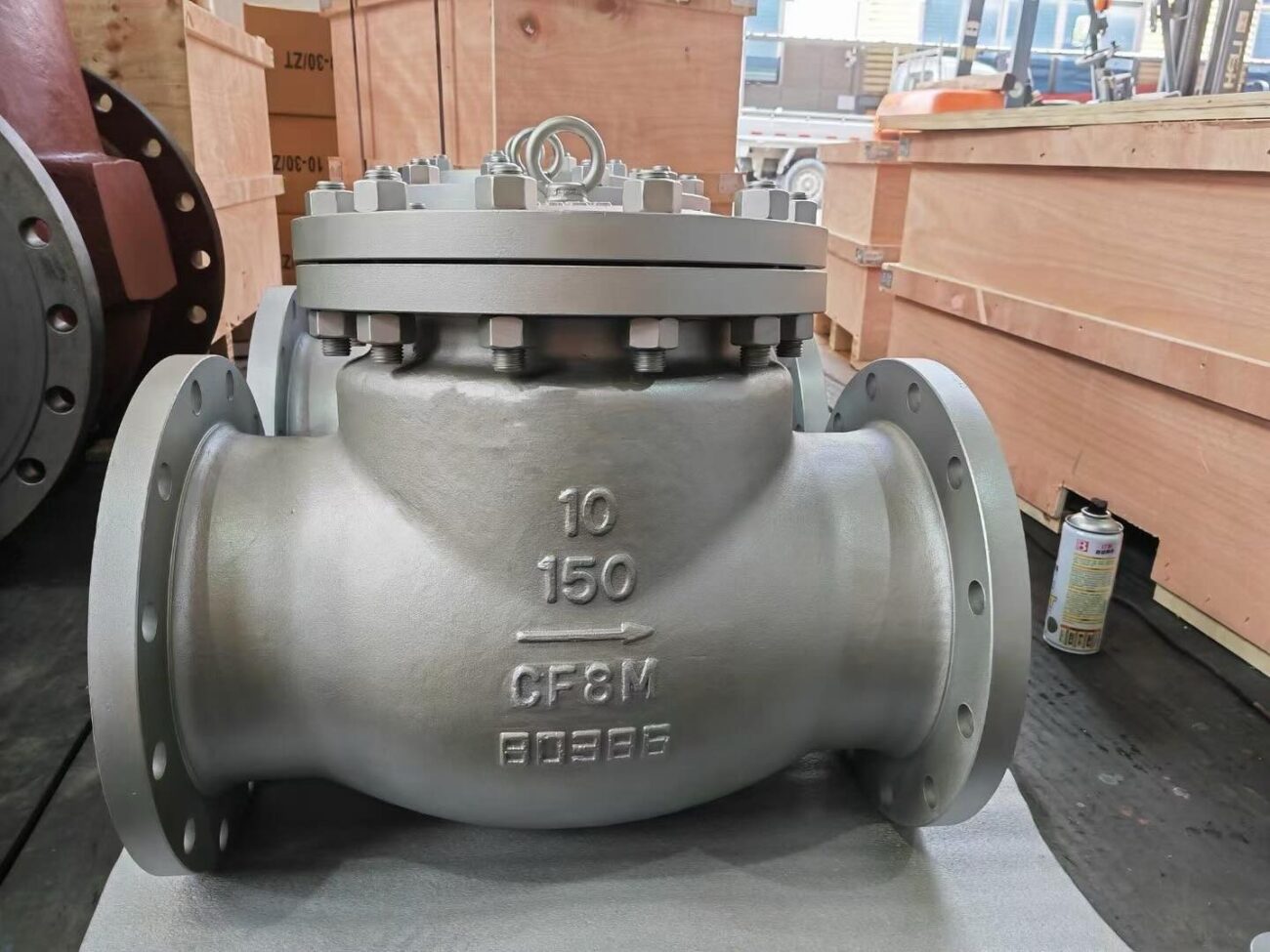
a. Swing Check Valves
- Include a hinged disc that opens as forward flow occurs.
- Perfect for horizontal configurations and lines with low velocity.
- Frequent in general utility pipelines, irrigation, and water delivery.
b. Lift Check Valves
- Disc piston moves up and down.
- Top for systems with clean fluids under great pressure.
- Frequently used in oil, chemical, and refinery activities involving steam.
c. Wafer Check Valves
- Weight- and size-optimized compact body.
- Excellent for small areas, fits between flanges.
- Commonly used in industrial water systems, district cooling, and HVAC.
d. Dual Plate / Dual Disc Check Valves
- Two spring-loaded plates reduce slamming and water hammer.
- Suited for large pipeline networks and fast-closing requirements.
e. Tilting Disc Check Valves
- Disc tilts rather than swings, offering smoother closure.
- Effective in large-diameter and high-flow environments.
f. Ball Check Valves
- Spherical element seals the valve during reverse flow.
- Preferred in slurry, wastewater, and viscous fluid lines.
Design Standards
Check valves are engineered according to global standards that define pressure limits, testing methods, material requirements, and performance benchmarks. Common design frameworks include:
- API 594 – Covers wafer, lug, and double-plate check valves.
- API 598 – Defines pressure testing for metal-seated valves.
- ASME B16.34 – Specifies pressure–temperature ratings and material classes.
- ISO 5208 / ISO 5752 – Governs leak testing and face-to-face dimensions.
These standards ensure consistent flow behavior, controlled closure, and predictable performance across different industrial conditions.
Design Expectations vs Operation Behavior
Check valve design affects how they respond to changing flow conditions, closing speed, slamming tendencies, and mounting requirements.
| Design Expectations | Operation Behavior |
| Defined by disc/plate geometry | Flow opens the valve automatically |
| Body material influences corrosion and temperature resistance | Reverse flow triggers closure |
| Hinge mechanism or spring action determines closure rate | Spring-loaded options close faster than swing types |
| End connection type affects installation (flanged, wafer, threaded) | Turbulence, velocity, and pressure changes impact disc movement |
| Design standards specify pressure limits, dimensions, and material compatibility | Vertical vs horizontal installation affects performance |
Understanding these differences helps engineers match valve design to system behavior.
Internal Dynamics of Check Valves
Check valves rely entirely on differential pressure.
Opening Phase
- Fluid pressure on the inlet side pushes the disc/ball/plate open.
- The valve creates a low-resistance pathway, maintaining stable flow.
Closing Phase
- When flow decreases or reverses, gravity, springs, or back pressure push the disc back to its seat.
- The purpose is to eliminate backflow and shield system components from reverse pressure.
Key Internal Dynamics
- Lift valves rely on vertical disc travel.
- Swing valves depend on hinge rotation.
- Dual plates use torsion springs for rapid closure.
- Ball valves use seated spherical movement.
Each mechanism influences speed, noise reduction, and suitability for various media.
Flow Characteristics and Mechanism
Flow dynamics directly affect check valve performance.
Flow Characteristics
- Low pressure drop when fully open
- Laminar flow in lift and silent check valves
- Swing-type valves may experience minor turbulence
- Quick-closing designs reduce water hammer
Mechanism Influence
- Spring-assisted valves offer smoother flow stability
- Larger valves require disc weight balancing
- Media with solids may require ball-type designs
Engineers must consider velocity, pressure, and media composition.
Comparison of Check Valves
| Feature | Swing | Lift | Dual Plate | Ball | Wafer | Tilting Disc |
| Closure Speed | Slow | Medium | Fast | Medium | Fast | Medium–Fast |
| Water Hammer Risk | Higher | Moderate | Low | Moderate | Low | Very Low |
| Space Requirement | Medium | High | Very low | Low | Very Low | Medium |
| Media Type | Clean liquids | Clean fluids/steam | Water & gases | Slurries | Clean liquids/gases | Clean & moderately viscous fluids |
| Installation | Horizontal | Vertical/Horizontal | Both | Both | Both | Horizontal preferred, vertical possible |
A Check Valve Is Ideal at What Time?
A check valve is most effective when:
- The system needs automatic backflow prevention
- Pumps start and stop frequently
- Pressures fluctuate within short cycles
- Vertical pipelines require rapid closure
- Process safety demands non-return functionality
- Lines must remain isolated without manual intervention
Its purpose is to safeguard flow direction integrity with minimal interaction.
Industrial Standards and Testing Requirements
Each valve must undergo:
- Hydrostatic shell and seat testing (API 598 / ISO 5208)
- Pressure-temperature compliance (ASME B16.34)
- Dimensional validation (ASME B16.10 / API 594)
- Material compatibility testing
- Fire-safe certification if required (API 607)
- NACE MR0175 / ISO 15156 for sour service
Standards ensure the valve meets rigorous operational demands.
Applications
Check valves are used anywhere backflow prevention and steady directional flow are required. Key applications include:
- Water and wastewater transfer
- Oil & gas pipelines and pumping stations
- HVAC and district cooling systems
- Chemical and petrochemical processing units
- Power generation and steam handling
Role of Check Valves in System Pressure Stability
By stopping reverse flow and abrupt pressure spikes, check valves help to keep pipeline pressure in equilibrium. The valve opens with little resistance when the media goes in the proper direction; yet, the instant backflow happens, the disc shuts instantly to assist balance pressure profiles across pumps, compressors, and distribution lines.
Essential responsibilities consist of:
- Lowering abrupt column reversal in liquid systems helps minimize water hammer.
- Maintaining pump efficiency by stopping backflow-induced pressure decreases into the suction line.
- Encouraging rotating equipment’s seamless startup and shutdown cycles.
- Keeping system integrity in setups with several pumps or high pressure.
- Lessening load swings in pipes processing changing flow velocities.
Check valves automatically respond to pressure fluctuations, therefore helping to keep a more uniform operating environment, which extends mechanical equipment life and shields critical components from pressure-induced stress by doing so. If you wish, I might create a variant specifically suited for oil & gas, HVAC, or water distribution networks.
Essential components in avoiding backflow, protecting pumps, and stabilizing fluid flow in industrial applications are check valves. Whether they pick swing, lift, twin plate, silent, or ball versions, engineers have to assess flow circumstances, pressure ranges, medium features, and installation environment. Following international guidelines such API 6D, API 598, ASME B16.34, and ISO 5208 ensures the chosen check valve keeps safe and consistent system performance across pipelines and process apparatus.