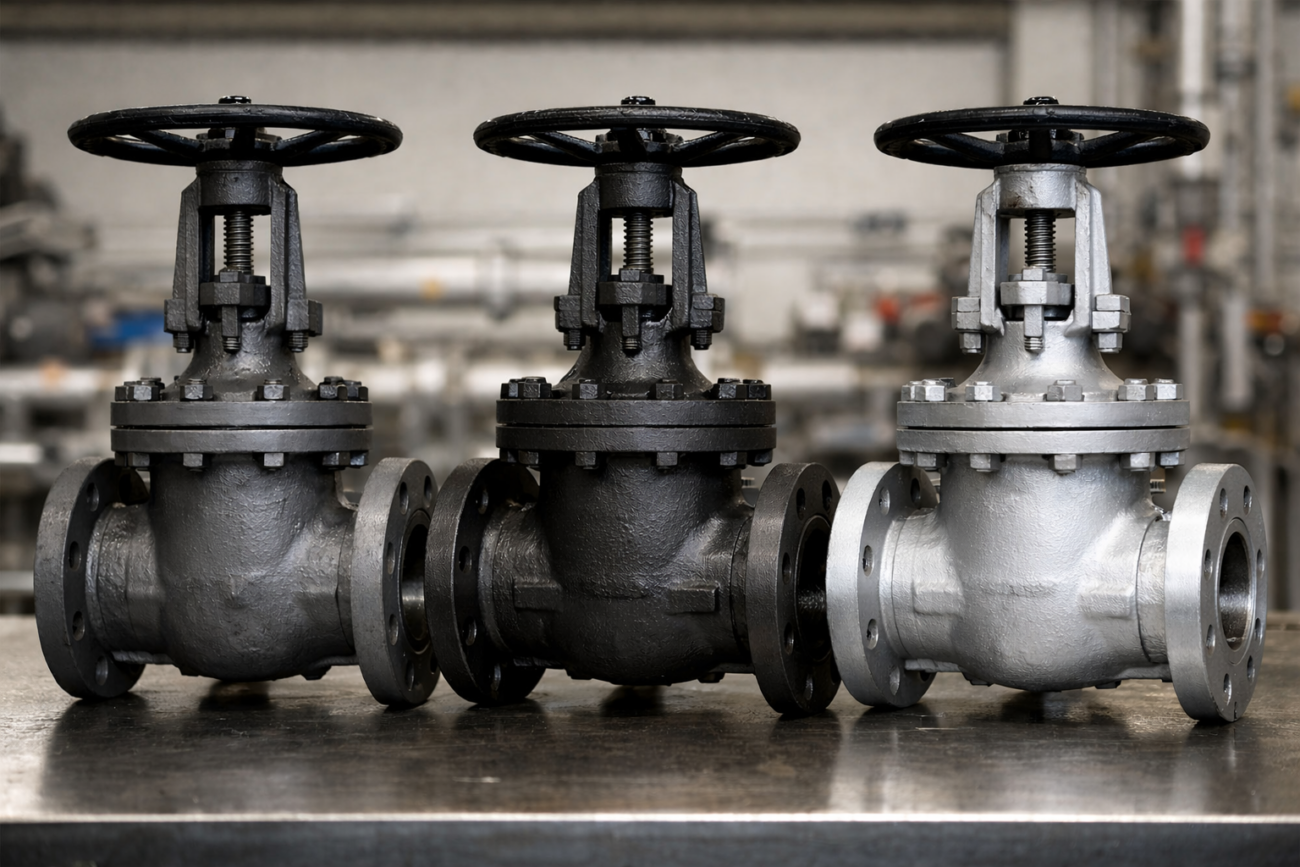
Carbon steel valve grades WCB, WCC, and LCB are widely used in industrial piping systems, but they are not interchangeable. Each grade is designed for a specific combination of pressure, temperature, and mechanical performance, and selecting the wrong one can lead to brittle fracture, leakage, or premature valve failure.
The primary difference between WCB, WCC, and LCB lies in strength and temperature tolerance.
- WCB is used for general industrial service at moderate pressure and temperature.
- WCC offers higher tensile strength for elevated pressure systems.
- LCB is specifically engineered for low-temperature applications, where standard carbon steel becomes brittle.
Industries such as oil & gas, petrochemicals, power generation, and LNG processing rely on correct carbon steel valve grade selection to ensure safety, code compliance, and long-term reliability. Understanding how these grades differ is essential for engineers, EPC contractors, and procurement teams responsible for material selection in critical service conditions.
Understanding ASTM Carbon Steel Specifications
Carbon steel valves are made in accordance with ASTM (American Society for Testing and Materials) standards for a particular chemical composition and mechanical characteristics, heat treatment and testing for valve materials.
The two most important ASTM standards in relation to carbon steel valves include the following:
- ASTM A216 – Cast carbon steel materials intended for high-temperature service
- ASTM A352 – Cast carbon steel materials intended for low-temperature service
These standards specify that valves meet some minimum requirements in terms of strength, ductility, impact properties, and pressure containment. It is thus necessary to comply with ASTM standards to meet the project specifications and international codes.
ASTM A216 WCB Valves
ASTM A216 WCB (Wrought Carbon Steel, Grade B) is actually the most popular carbon steel material specification for industrial valves. It is regarded as good enough in general strength and toughness, yet inexpensive and therefore applicable in many areas.
Key Characteristics of WCB Valves
- Temperatures and pressures appropriate for moderate viewing applications
- Good machinability and weldability, making fabrication and maintenance fairly easy
- Normally, the operating temperature would be around –29°C to 425°C.
- Good mechanical strength for general-purpose service
Typical Uses
WCB valves find foremost application in:
- Refinery and petrochemical complex
- Power generation process facilities
- Oil and gas processing unit
- Water, steam, and hydrocarbons activities
Due to its availability and versatility, WCB is most often the default choice unless specific pressure or temperature environment dictates another grade.
ASTM A216 WCC Valves
The ASTM A216 WCC is a higher-strength carbon steel grade as compared to WCB. Its higher carbon content increases its tensile strength and pressure handling capabilities.
Key Attributes of WCC Valves
- Higher tensile and yield strength than WCB
- Appropriate for higher pressure applications
- Slightly inferior ductility with respect to WCB
- Same temperature range as WCB, generally –29°C to 425°C
Typical Applications
WCC valves are used in applications like:
- High-pressure piping systems
- Oil and gas transmission lines
- Process units that exceed WCB pressure margins
WCC is superior in strength but has lower ductility and hence must be used judiciously in systems subjected to thermal cycling and vibration.
ASTM A352 LCB Valves
The ASTM A352 LCB is a material intended to be used primarily for low-temperature service, while standard carbon steels may become brittle and fracture.
Key Characteristics of LCB Valves
- Enhanced impact toughness at sub-zero temperatures
- Operating temperature range down to -46
- Decreased carbon content enhances toughness
- Mandatory impact test for low-temperature performance
Typical Applications
LCB valves are commonly used for:
- LNG processing and storage facilities
- Low-temperature hydrocarbon services
- Cryogenic-adjacent applications
- Low-temperature oil and gas installations in cold climates
Wherever low-temperature resistance may prove to be critically important to safety, LCB would be selected.
Comparison: WCB vs WCC vs LCB
| Property | WCB | WCC | LCB |
| ASTM Standard | ASTM A216 | ASTM A216 | ASTM A352 |
| Carbon Content | Medium | Higher than WCB | Lower than WCB |
| Tensile Strength | Medium | High | Medium |
| Yield Strength | Medium | High | Medium |
| Temperature Range | –29°C to 425°C | –29°C to 425°C | Down to –46°C |
| Low-Temperature Toughness | Limited | Limited | Excellent |
| Impact Testing Requirement | Not mandatory | Not mandatory | Mandatory |
| Pressure Suitability | Medium-pressure systems | High-pressure systems | Medium-pressure, low-temperature systems |
| Ductility | Good | Lower than WCB | Good |
| Typical Valve Types | Gate, Globe, Ball, Check | Gate, Globe, Ball | Gate, Globe, Ball, Check |
| Common Applications | General industrial service | High-pressure oil & gas systems | LNG, low-temperature hydrocarbons |
| Risk if Misapplied | Reduced lifespan | Brittle cracking under cycling | Unsafe at higher temperatures |
| Relative Cost | Standard | Slightly higher | Higher than WCB |
| Impact Testing Requirement | Not mandatory for standard service | Not mandatory; strength-focused material | Mandatory Charpy impact testing for low-temperature service |
Applications and Selection Guidelines
The important consideration that goes with the selection of the right grade for this carbon steel valve relates to the operating conditions, safety requirements, and code compliance.
Guidelines for selection
- For general applications of medium pressure and temperature choose WCB
- For systems that demand strength against higher pressure, use WCC
- Use for low temperature or cold environment applications, use LCB
Another important thing to consider is:
- Limits of operating pressure & temperature
- Process media & corrosion potential
- Applicable codes & project specifications
- Long-term maintenance and inspection criteria
UAE Valves is a leading carbon steel valve grade supplier providing facilities for proper material selection in safe compliance with reliability operations for various industries.
Advantages of the proper selection of carbon steel valve:-
Correct grade has operation advantages such as:
- Higher security and decreased risk of failure of the material
- Improved durability and better valve performance
- Standards conformance with international standards and project requirements
- Cost-cutting in maintenance and replacement
- Increase reliability and uptime of systems.
Selecting the correct carbon steel valve grade is critical to ensuring operational reliability, safety, and regulatory compliance. As similar as they appear, WCB, WCC, and LCB are very different from each other when it comes to strength and temperature performance, making each of these valves applicable in different areas. Knowing these differences then prevents unnecessary failure, leakages, and costly downtimes. UAE valves are a leading WCBs, WCCs, and LCB valve suppliers, providing reliable facilities with regards to standards compliance for oil, gas, and industrial applications globally.